
Monday evening, my husband and I attended Awards Night at Gesher Human Services. Its mission is “to be a bridge to hope and opportunity for people at work, at home, and in the community.” Gesher, the Hebrew word for bridge, reflects the work of helping people crossover to where they want to be.
I left feeling inspired by the speakers and the stories of people finding their way forward. And I began thinking: Aren’t we all standing before a bridge at some point in our lives? Aren’t we all “immigrants” in one way or another? Not necessarily to another country, but to new circumstances, neighborhoods, relationships, and versions of ourselves?
I think back to 1961, when I moved from the South Side of Chicago to West Bloomfield as a six-year-old. I arrived carrying memories, expectations, hopes, and fears. Would I fit in at Green School? Would I be welcomed? Would I find my people?
Our families are our first communities… Our siblings our first best friends. Then come the playground, the classroom, the child who saves us a seat, the neighbor who invites us over, and the friend who shares a lunch or a secret. We begin learning the rules of belonging.
Some friendships last a lifetime; others last only a season. As we move through schools, neighborhoods, jobs, marriages, parenthood, and new cities, we find communities, leave them, and sometimes outgrow them. But one thing remains constant: belonging isn’t simply about being surrounded by people. It’s about being known.
Throughout life, we face familiar questions: Where do we go when we need help? Who can we trust? How do we make a friend? What do we have to offer? These questions belong to the immigrant arriving in a new country, the child starting school, the employee beginning a new job, and the older adult moving into Jewish Senior Life.
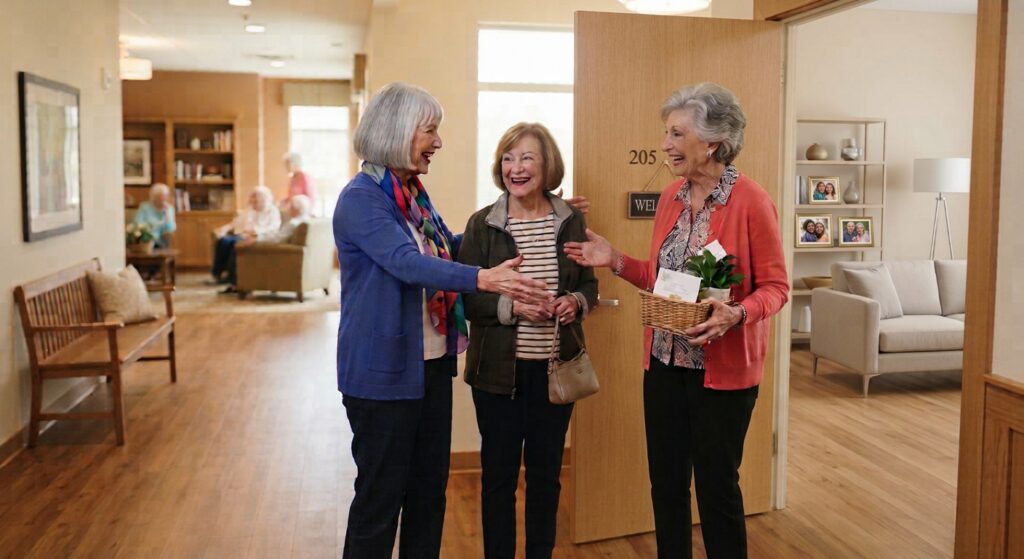
One day, we may find ourselves starting over at 80.
Imagine having lived in the same home for over 50 years. We know every corner of our neighborhood, our favorite grocery store, our doctors, our neighbors, and the routines that make life familiar. And then, suddenly, everything is new.
New surroundings, new faces, new routines, and a whole new set of unwritten social rules. We may be surrounded by people and still feel alone. We may sit at a table with five people and wonder how to enter the conversation or walk into an activity feeling like the new kid on the playground.
In some ways, it can feel like moving to another country. We haven’t lost our identity, but the environment in which that identity was understood has changed. We can find our footing again. At 80, we can still be the new kid. We can still look for our first friend.
Our children are the ones suggesting ways to make life easier. What they see as a new beginning, we may experience as an ending. They see the possibilities ahead, while some are still mourning what we’ve left behind.
We may arrive carrying losses: spouses, siblings, old friends, familiar neighborhoods, and sometimes the independence we once took for granted. A new friendship doesn’t replace the people we’ve loved. It simply makes room for someone new.
So how do we cross over? Maybe it begins just as it did on the playground: someone says hello, invites us to play, remembers our name, or asks us to take a walk with them. It sounds simple, but it takes courage. Someone must make the first move and be willing to try again.
Community isn’t just a place. It’s something we create. It’s the person who notices when we aren’t at breakfast, the neighbor who checks in, the friend who remembers something we shared, or the staff member who takes the time to learn our story.
A community becomes meaningful when people feel they matter. And that responsibility belongs to all of us, not just the newcomer or the person who feels lonely, but those who are already there.
The greatest act of community is recognizing someone who is still finding their way and helping them feel welcome…. Welcoming the stranger…. Making room at the table.
We’re all immigrants in some way. Life keeps moving us. We leave places we thought we would never leave, lose people we thought would always be there, and enter unfamiliar circumstances. Again, we begin anew.
Whether we’re 8, 18, 48, or 88, the need is remarkably similar. We want to be welcomed, remembered, included, and understood. Don’t we all want someone to sit beside us? Someone who notices we’re there? Somewhere we can feel at home?
The real question isn’t whether we belong somewhere. It’s whether we’re willing to keep finding our way toward one another. We should never assume someone is too old, too experienced, or too independent to need help finding their way in.
And that’s what a bridge really offers: not just a way from one side to another, but the hope that something meaningful is waiting when we arrive.
May we find the courage to cross whatever bridge lies before us, and may WE be the bridge for someone else still finding their way.
May we arrive with hope, be welcomed with kindness, and discover that there is still so much waiting for us on the other side.
SHABBAT SHALOM